Flow Switch

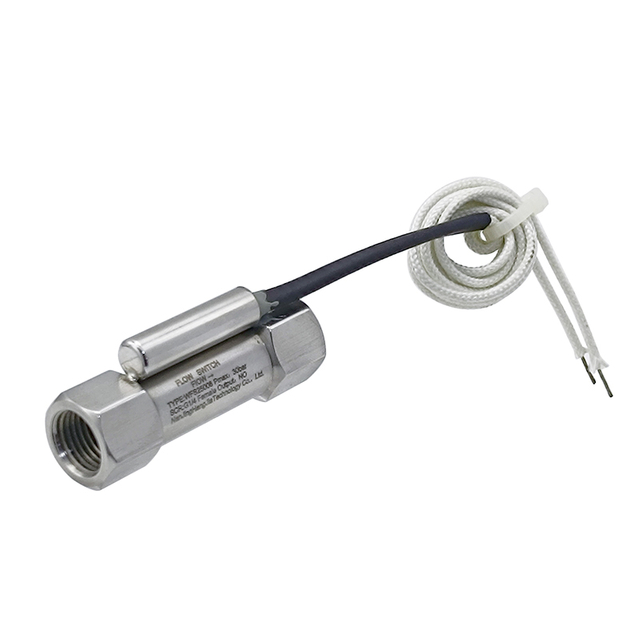
Flow Switch
A pump running dry, a cooling line blocked, or a filter clogged can destroy equipment in minutes. A flow switch is the simple, reliable sentinel that watches your flow and acts immediately – no PLC needed, no complex programming.
Here you'll discover flow switches for liquids, gases, and steam – from mechanical piston models and thermal dispersion switches to explosion‑proof and digital display types. On this page, we help you choose the right sensing principle, output (reed switch, PNP/NPN, relay), and connection so your system stays safe and your processes never run without flow.
What Is a Flow Switch?
A flow switch is an electromechanical or electronic device that detects the presence or absence of flow in a pipe or duct. When flow exceeds or falls below a preset rate, the switch changes state – opening or closing a circuit, activating a relay, or sending a signal to a PLC or alarm.
Unlike a flow meter (which gives a continuous measurement), a flow switch gives a simple on/off indication: “flow is too low” or “flow is too high”. It is rugged, easy to install, and designed for years of maintenance‑free operation.
Two common technologies dominate industrial flow switching:
Mechanical (piston) flow switches – use a spring‑loaded piston or vane that moves with flow. A magnet inside triggers a reed switch. Simple, low‑cost, excellent repeatability, and they work with both liquids and gases.
Thermal (calorimetric) flow switches – use a heated sensor and a reference sensor. The cooling effect of the flowing medium changes the temperature difference, which is converted into a switching signal. No moving parts, ideal for low flow rates and aggressive media, and they work with liquids, gases, and even some slurries.
Types of Flow Switches We Offer
Our flow switch portfolio covers mechanical piston designs, thermal dispersion switches, and advanced digital display models.
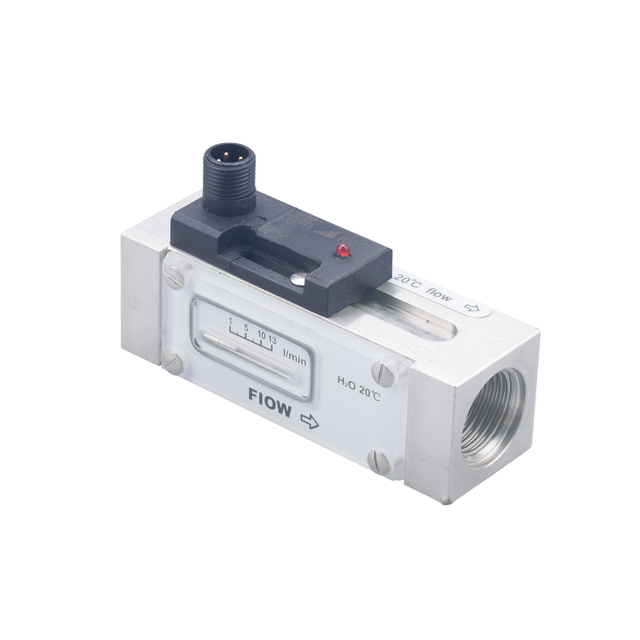
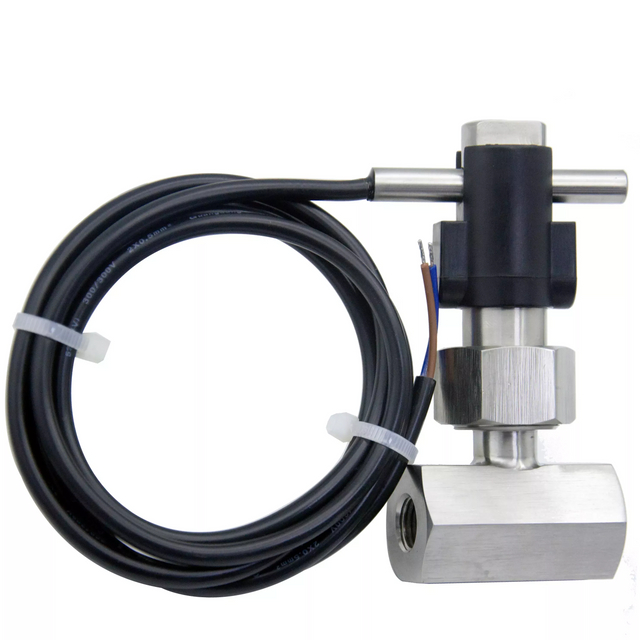
Mechanical Piston Flow Switch (FS Series / FCS20)
A spring‑loaded piston sits in the flow path. When flow pushes the piston against the spring, a magnet inside moves past a reed switch, triggering the output. When flow stops, the spring returns the piston and the switch resets. The setpoint can be adjusted by changing the spring (or using an adjustable bypass). These switches are robust, have very low pressure drop, and are available in brass, anodised aluminium, or stainless steel.
Best when you need:
A simple, reliable on/off flow switch for water, oil, or air.
Low cost and easy installation in pipes from G1/4 to G1.
Contact rating up to 24 VDC / 220 VAC, 100 mA (reed).
Compact size, good repeatability, minimal maintenance.
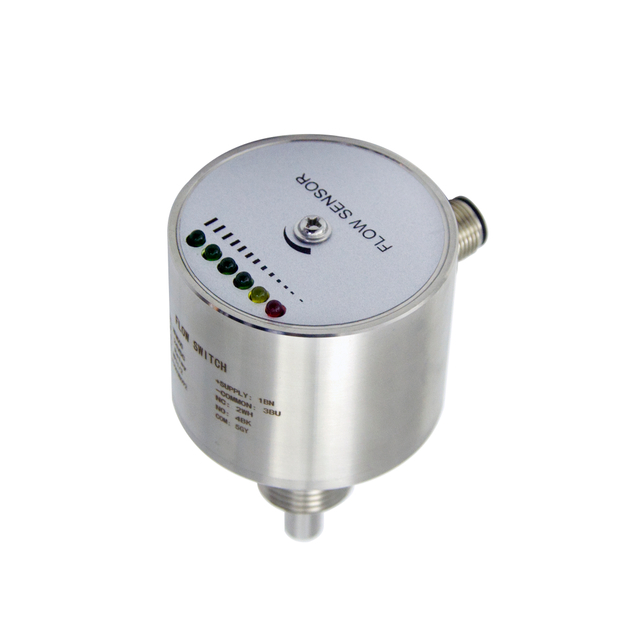
Thermal Dispersion Flow Switch (UNC‑F24 / HFM510)
A thermal flow switch has no moving parts. It contains a heated temperature sensor and a reference sensor. Flow carries heat away from the heated sensor, creating a temperature difference that is proportional to flow velocity. An internal comparator triggers the switch when the temperature difference crosses a set threshold. The setpoint is adjustable via a potentiometer. Models with LED bar graphs (4 green, 1 yellow, 1 red) show flow relative to the setpoint. Explosion‑proof versions (Ex d) are available for hazardous areas.
Best when you need:
No moving parts – no wear, no clogging, ideal for dirty or low‑flow applications.
Detection of very low flow velocities (1 cm/s for water, 20 cm/s for air).
Operation with corrosive or high‑purity liquids (no contact with moving parts).
Explosion‑proof (Ex d) version for Zone 1/2 areas.
Digital display with push‑button setpoint adjustment (HFM510).
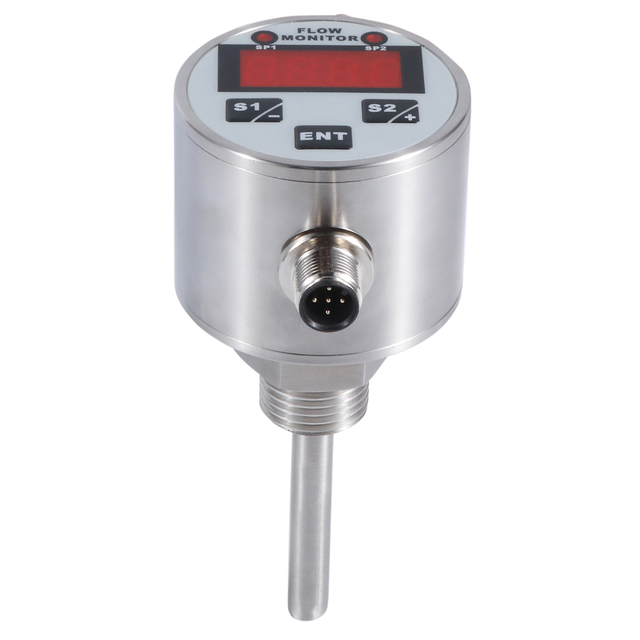
Digital Display Thermal Flow Switch (HFM510)
The HFM510 is a thermoelectric flow switch with a built‑in 4‑digit LCD display and push‑button configuration. It provides two PNP or NPN switch outputs, optional 4‑20 mA analog output, and relay output models. The display shows instantaneous flow velocity (cm/s) and switch status. All wetted parts are stainless steel 304, and the housing is IP67. It can be used for water, oil, and air, with measurement ranges down to 1 cm/s.
Best when you need:
Local readout of flow velocity and switch status.
Two independent setpoints (e.g., low flow alarm and high flow alarm).
Analog output for trend monitoring.
Flexible output configuration (PNP, NPN, relay, or analog).
Quick comparison
| Model | Technology | Media | Flow range | Output | Special feature |
|---|---|---|---|---|---|
| FS / FCS20 | Mechanical piston | Water, oil, air | 0.6~70 L/min (water) | Reed switch (NO/NC) | Low cost, compact, spring‑loaded piston |
| UNC‑F24 | Thermal (calorimetric) | Water, oil, air | 1~150 cm/s (water) | PNP/NPN/relay | Explosion‑proof (Ex d), LED bar graph |
| HFM510 | Thermal with display | Water, oil, air | 1~150 cm/s (water) | 2×PNP/NPN, relay, 4‑20 mA | 4‑digit LCD, push‑button setting, two outputs |
Flow Switch Applications by Industry
Cooling & Lubrication Circuits
Machine tools, welding equipment, laser systems, and large transformers rely on continuous coolant flow. A flow switch installed in the cooling line shuts down the equipment or triggers an alarm if flow drops below a safe level – preventing overheating and costly damage.
Pump Protection
When a pump runs dry, seals and bearings fail within minutes. A flow switch on the discharge side (low flow detection) stops the pump before damage occurs. For booster pumps, a flow switch can start the pump when flow is demanded and stop it when flow ceases.
HVAC & Chilled Water
Air handling units, chillers, and boiler systems use flow switches to verify that water or glycol is circulating before allowing compressors or heaters to operate. Thermal switches (no moving parts) are preferred because they do not get stuck by debris.
Chemical & Water Treatment
Dosing pumps, filter presses, and reverse osmosis systems need to know when flow is present. A thermal flow switch with a stainless steel probe resists corrosion. Explosion‑proof models (UNC‑F24) are used in hazardous areas where solvents or flammable gases are present.
Air & Gas Systems
Compressed air lines, ventilation ducts, and gas burners require flow verification. Mechanical switches work for higher flow rates; thermal switches are excellent for low air velocities (down to 20 cm/s).
How to Choose the Right Flow Switch
Determine the media and flow range
Water, oil, air (moderate to high flow) – mechanical piston switch (FS/FCS20) is economical and reliable.
Low flow, dirty media, corrosive fluids – thermal switch (UNC‑F24 or HFM510) with no moving parts.
Very low flow (e.g., 1 cm/s water) – thermal type is the only option.
Choose the output type
Reed switch (dry contact) – for direct connection to PLC input or small relay (24 VDC / 220 VAC, ≤100 mA). Use an interposing relay for higher loads.
PNP or NPN transistor output – for 24 VDC circuits and modern PLCs. Sourcing (PNP) is most common.
Relay output (UNC‑F24, HFM510) – can switch larger loads (up to 4 A) directly to pumps or alarms.
Analog output – for flow velocity trending in addition to switching.
Consider installation requirements
Pipe size – mechanical switches are available with G1/4, G3/8, G1/2, G3/4, G1 threads. Thermal switches use a threaded probe (e.g., G1/2) that inserts into the pipe via a weld‑on boss or tee.
Materials – brass or anodised aluminium for general water/air; stainless steel for corrosive media or high purity.
Pressure rating – mechanical switches up to 50 bar (aluminium) or 100 bar (stainless). Thermal switches up to 100 bar.
Temperature – mechanical up to 110 °C; thermal up to 80 °C standard (higher on request).
Hazardous area requirements
For Zone 1 or Zone 2 explosive atmospheres (gas, vapour, dust), choose the UNC‑F24 explosion‑proof thermal flow switch (Ex d IIC T6). Do not use a standard mechanical switch.
Flow Switch FAQs
What is the difference between a flow switch and a flow meter?
A flow switch provides a simple on/off signal (flow / no flow, or flow above/below a setpoint). A flow meter gives a continuous reading of flow rate (e.g., litres per minute). Use a switch for protection, interlocking, and alarms. Use a meter for process monitoring and batch control.
Can a mechanical flow switch be used for low flow rates?
The FS/FCS20 series has models with setpoints as low as 0.6 L/min (water). For even lower flows (e.g., 0.1 L/min or cm/s), a thermal flow switch is more suitable.
How do I adjust the setpoint on a thermal flow switch?
On the UNC‑F24, turn the potentiometer while observing the LED bar graph. Turn clockwise to increase the setpoint (making the switch harder to close), counter‑clockwise to decrease. On the HFM510, use the front buttons: enter the menu, set the desired switch point in cm/s, and exit. The display shows the current flow velocity.
Can I use a flow switch with a pulsating flow (e.g., from a peristaltic pump)?
Yes, but you may need to add a stabiliser or increase the response delay (if available). Thermal switches can average the signal. For mechanical switches, pulsations can cause chattering; a time‑delay relay in the circuit helps.
What happens if a thermal flow switch gets coated with oil or scale?
A thin, conductive coating can affect accuracy. Thermal switches are more tolerant than mechanical switches (no moving parts to stick), but heavy build‑up should be avoided. For extremely dirty applications, consider an insertion style with a cleaning schedule or a mechanical switch with a larger piston clearance.
Do I need a straight pipe run before a flow switch?
For mechanical piston switches, some straight run helps but is not critical because the piston is in the flow stream. For thermal switches, it is recommended to have 5× pipe diameters upstream and 3× downstream to ensure a representative velocity profile. For tight spaces, thermal switches are more forgiving than turbine meters.
Why Choose Our Flow Switches?
We design and manufacture flow switches using two field‑proven technologies – mechanical piston and thermal dispersion – to cover the widest range of applications.
Robust & Reliable
Mechanical – spring‑loaded piston, magnetically coupled reed switch. No electronics to fail. Suitable for temperature up to 110 °C, pressure up to 100 bar.
Thermal – all stainless steel probe, solid‑state electronics, no moving parts. LED status indication, explosion‑proof option.
Easy To Install & Set
Compact threaded connections (G1/4 to G1) for easy insertion into existing piping.
Thermal models include a potentiometer or push‑button menu; no calibrations needed for most media.
IP65 to IP67 protection, suitable for indoor or outdoor use.
Flexible Outputs
Reed switch (NO/NC), PNP/NPN transistor, relay (up to 4 A), and 4‑20 mA analog.
Single or dual switch points (HFM510) for low‑high alarms.
Fast Support & Customisation
Our engineers help you select the right flow switch technology based on your fluid, pipe size, flow range, and environmental conditions. We can customise probe lengths, thread types, and setpoint calibrations for OEM orders.