Liquid Level Sensor


Liquid Level Sensor
Accurate level measurement prevents tank overflows, pump dry‑running, and inventory errors. A failed level sensor can shut down your process fast – whether you are monitoring a deep well, a chemical reactor, or a river gauge.
Here you'll discover liquid level sensors for water, wastewater, corrosive chemicals, and sticky media – from submersible hydrostatic probes and non‑contact ultrasonic meters to high‑frequency radar level transmitters.
On this page, we help you choose the right measuring principle, range, output signal, and mounting style so your level monitoring is safe, reliable, and maintenance‑free.
What Is a Liquid Level Sensor?
A liquid level sensor measures the height of a liquid in a tank, well, or open channel. It turns the physical level into an electrical signal – typically 4‑20 mA, 0‑10 V, or digital (RS485/Modbus) – that a PLC, display, or control system can read.
Different applications call for different sensing technologies. The most common industrial level sensors fall into two categories:
Contact sensors – submersible hydrostatic probes that measure the pressure exerted by the liquid column. They are immersed directly into the liquid.
Non‑contact sensors – ultrasonic and radar meters that emit sound or electromagnetic waves from above the liquid surface. They never touch the medium, making them ideal for corrosive, sticky, or hygienic applications.
Types of Liquid Level Sensors We Offer
Our level sensor portfolio covers the three most widely used industrial technologies: submersible hydrostatic, ultrasonic, and radar (FMCW). Each has its own strengths.
Submersible Hydrostatic Level Transmitter
This is the workhorse for tank, well, and river level measurement. The sensor is lowered into the liquid and measures the hydrostatic pressure of the column above it. Because hydrostatic pressure is directly proportional to height times density, the transmitter outputs a level signal (usually scaled in meters of water column). The vented cable allows atmospheric pressure to cancel out barometric changes.
Best when you need:
Continuous level measurement in water, wastewater, groundwater, or fuel.
A cost‑effective, rugged probe for depths up to 500 m.
4‑20 mA, HART, RS485, or relay outputs.
Simple installation – just lower the probe and secure the cable.
Our models include:
HPM410 – general purpose, 316L, ranges 1~500 mH₂O.
HPM4119 – mini‑diameter (19 mm) for narrow boreholes.
HPM410‑C – anti‑sand & waterweed filter ring for rivers and reservoirs.
HPM47W‑CSN – ceramic capacitive sensor for corrosive liquids (seawater, chemicals).
Ultrasonic Level Meter
An ultrasonic level meter works non‑contact: it emits a high‑frequency sound pulse from a transducer mounted above the liquid. The pulse reflects off the surface, and the time of flight is converted into distance. Because sound speed varies with temperature, most units have built‑in temperature compensation.
Best when you need:
Non‑contact measurement for corrosive, viscous, or dirty liquids.
Easy installation – no need to enter the tank or well.
Ranges from 5 m up to 25 m (longer on request).
Integrated display and relay outputs for pump control.
Our models include:
HWU30 – integrated ultrasonic (probe + electronics in one housing), up to 25 m, 4‑20 mA + RS485 + relays.
HGU32 – split ultrasonic (wall‑mounted display, probe separate), up to 25 m, easy configuration via keypad.
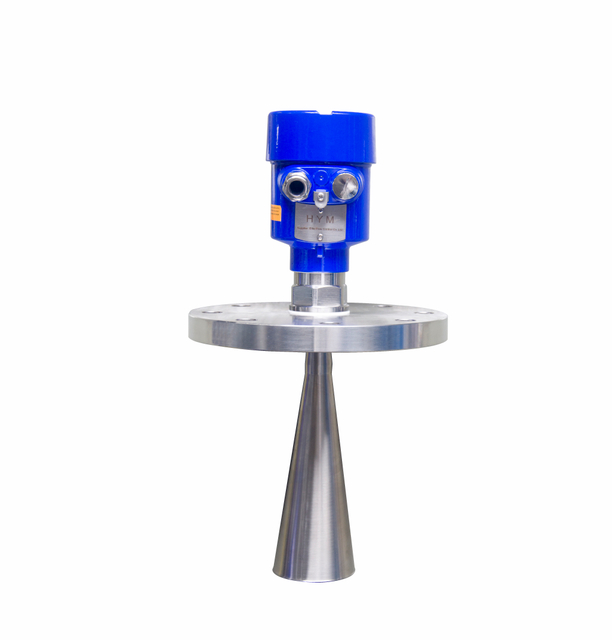
Radar Level Meter (80GHz & 26GHz)
Radar level meters use frequency‑modulated continuous wave (FMCW) technology – typically in the 26 GHz or 76 GHz (80 GHz) band. The radar beam has a very narrow angle (as low as 3°), high penetration, and is unaffected by temperature, pressure, vapour, dust, or foam. 80 GHz radar (millimeter wave) offers even higher resolution and a smaller blind zone (as low as 8 cm).
Best when you need:
Non‑contact measurement in extreme conditions: high dust, steam, foaming, or agitation.
Very high accuracy (±1~3 mm) and large ranges (up to 120 m).
Measurement of solids (powders, grains, pellets) as well as liquids.
Operation under high pressure (up to 4 MPa) or high temperature (up to 200 °C).
Our models include:
HWM500 (80 GHz) – very narrow beam, up to 120 m, blind zone 8 cm, PTFE antenna.
HWM510 (26 GHz) – proven technology, up to 80 m, horn antenna, ±3 mm accuracy.
Quick comparison
| Technology | Contact / Non‑contact | Range | Accuracy | Best for |
|---|---|---|---|---|
| Submersible hydrostatic | Contact (immersed) | 1~500 m | ±0.5% FS | Clean water, wells, tanks, wastewater |
| Ultrasonic | Non‑contact (sound) | 5~25 m | ±0.25~0.5% | Corrosive, dirty, viscous liquids; open channels |
| 26 GHz radar | Non‑contact (microwave) | up to 80 m | ±3 mm | Dusty, steamy, foaming; solids and liquids |
| 80 GHz radar | Non‑contact (mmWave) | up to 120 m | ±1 mm | Narrow tanks, high precision, small blind zone |
Liquid Level Sensor Applications by Industry
Water & Wastewater
Lift stations, storage tanks, clarifiers, and rivers. Submersible probes (HPM410) are lowered directly into wet wells. For open channels or corrosive environments, ultrasonic (HWU30) or radar (HWM500) are mounted above the water, avoiding contact with debris.
Chemical & Petrochemical
Tanks containing acids, solvents, or fuels. Non‑contact radar (HWM510) is ideal because it resists corrosion, vapours, and pressure. For immersed measurement in compatible liquids, ceramic capacitive submersible (HPM47W‑CSN) with PTFE cable is available.
Food & Beverage
Sanitary level measurement in mixing tanks, fermentation vessels, and silos. Radar with PTFE antenna or ultrasonic with hygienic clamp mounting are used. Contact devices are avoided to prevent contamination.
Deep Wells & Groundwater Monitoring
Narrow boreholes (50 mm diameter) require a slim probe. HPM4119 (19 mm diameter) fits through small openings and provides long‑term stability. Data can be logged via RS485 or sent to a telemetry system.
Bulk Solids & Silos
Cement, grain, plastic pellets, and coal dust. Ultrasonic may be affected by dust; radar (especially 80 GHz) penetrates dust and measures reliably. HWM500 with a large PTFE antenna works well.
How to Choose the Right Liquid Level Sensor
1. Determine contact or non‑contact
Contact (submersible) – choose when you can safely immerse the probe, the medium is clean or mildly dirty, and you need a simple, rugged solution at low cost.
Non‑contact (ultrasonic or radar) – choose when the medium is corrosive, sticky, agitated, foaming, or very hot; also when you cannot enter the tank or well.
2. Consider the environment
Clear water, wastewater, light slurry – submersible (HPM410) or ultrasonic (HWU30) both work.
Heavy foam, steam, dust, condensation – radar (HWM500/510) is the only reliable choice. Ultrasonic may fail because foam absorbs sound.
Corrosive liquid (acid, seawater) – use submersible with ceramic sensor and PTFE cable (HPM47W‑CSN) or non‑contact radar with PTFE antenna (HWM500).
High pressure or vacuum – radar (up to 4 MPa) or submersible with a closed tank reference (differential pressure).
3. Range & accuracy
Short range (<10 m) with good access – ultrasonic is often the most economical.
Medium range (10~30 m) – ultrasonic or 26 GHz radar.
Long range (>30 m, up to 120 m) – 80 GHz radar (HWM500) is the best choice.
High accuracy (±1 mm) – 80 GHz radar.
General industrial accuracy (±0.25~0.5% FS) – submersible or ultrasonic.
4. Output & power
4‑20 mA loop‑powered – simple two‑wire connection, works with most PLCs.
4‑20 mA + HART – adds digital configuration and diagnostics.
RS485 / Modbus – for multi‑drop networks and data logging.
Relay outputs – direct pump control (high/low level alarms) without a PLC.
5. Installation & mounting
Submersible – requires a cable clip, weight, or mounting bracket. Keep the vent tube dry.
Ultrasonic / radar – requires a rigid mounting above the maximum level, with a clear path to the liquid surface. Avoid obstacles (pipes, ladders). The beam angle must not hit the tank wall.
Liquid Level Sensor FAQs
What is the difference between a submersible level transmitter and a radar level meter?
A submersible transmitter sits at the bottom of the tank and measures hydrostatic pressure. It is a contact device, simple and accurate, but must be compatible with the liquid. A radar meter sits above the liquid and measures the time of flight of microwaves. It is non‑contact, works in almost any medium (including solids), but costs more and requires careful aiming.
When should I use ultrasonic instead of radar?
Ultrasonic is less expensive and works well for clean water, mild chemicals, and open channels where dust and foam are not present. Radar is preferred when there is dust, steam, foam, condensation, or high temperature – ultrasonic will lose echo or give erratic readings.
Can a submersible level transmitter measure open channel flow?
Yes – by measuring the level in a weir or flume, the flow rate can be calculated using a standard equation (e.g., Manning equation). However, an ultrasonic or radar mounted above the flume is more common because it avoids sediment buildup. Our submersible probes can be used with a stilling well.
How deep can a submersible level transmitter go?
Our HPM410 series is available up to 500 mH₂O (about 500 m depth). The cable must be ordered to the correct length. For deeper applications, we can customise.
What is the blind zone of an ultrasonic level meter?
The blind zone is the distance immediately below the transducer where the sensor cannot measure because the transmitted pulse overlaps the reflected pulse. Typical blind zones are 0.25 m to 0.6 m. Always ensure the highest liquid level stays below the blind zone.
Do radar level meters work on solids?
Yes – 26 GHz and 80 GHz radar are widely used for powders, grains, pellets, and rocks. The narrow beam and strong penetration work well on sloped solids. For very low dielectric (plastic powder), 80 GHz is more reliable.
Why Choose Our Liquid Level Sensors?
We manufacture a complete range of level measurement technologies – from simple submersible probes to advanced 80 GHz radar. Every sensor is tested for accuracy, long‑term stability, and environmental sealing.
Robust Construction
Submersible – fully welded 316L titanium option, IP68, double‑sealed potting.
Ultrasonic – PVDF or PTFE probe, IP68, built‑in lightning protection.
Radar – PTFE or stainless steel horn, IP67/68, explosion‑proof optional (Ex ia).
Wide Selection
Ranges: 1 mH₂O to 500 mH₂O (submersible), 5 m to 25 m (ultrasonic), up to 120 m (radar).
Outputs: 4‑20 mA, HART, RS485, relays, Bluetooth (on some radar models).
Materials: 316L, titanium, PTFE, PVDF, ceramic Al₂O₃.
Easy to Specify & Install
Custom cable lengths, flanges, threads, and sanitary clamps available.
Submersible mounting accessories: cable clips, heavy hammers, protective tubes.
Ultrasonic/radar mounting brackets, alignment tools, and configuration guides.
Fast Support & Customisation
Our engineering team helps you select the right technology for your liquid, tank shape, and environmental conditions. For large projects, we provide free commissioning advice, sample testing, and custom calibrations.