Sanitary Pressure Transmitter




Sanitary Pressure Transmitter
Accurate and hygienic pressure measurement is non‑negotiable in food, beverage, and pharmaceutical production. A standard pressure transmitter with cavities or threads can trap product residue, leading to bacterial growth and failed inspections.
Here you'll discover sanitary pressure transmitters with flush diaphragm designs, tri‑clamp connections, and materials that withstand aggressive CIP/SIP cleaning. From basic level measurement in dairy tanks to high‑temperature reactor monitoring, we help you choose the right pressure range, output signal, and hygienic fitting so your process stays clean, safe, and compliant.
What Is a Sanitary Pressure Transmitter?
Sanitary Pressure Transmitter Definition & Working Principle
A sanitary pressure transmitter is a pressure measuring device designed specifically for applications where hygiene, cleanability, and contamination prevention are critical. Unlike standard industrial transmitters, sanitary models feature a flush or planar diaphragm that sits flush with the process connection. This eliminates dead zones, crevices, and threads where bacteria, product residue, or cleaning agents could accumulate.
Inside the transmitter, a pressure sensing element – either a silicon piezoresistive core (oil‑filled) or a dry ceramic capacitive sensor – converts the applied pressure into an electrical signal. The flush diaphragm directly contacts the process media and transmits the pressure to the sensing element via a small amount of filling fluid (silicone oil, olive oil, or a food‑grade medium). The signal conditioning circuit then outputs a standard 4‑20 mA, 0‑10 V, or HART signal for connection to PLCs, controllers, or displays.
Because the entire wetted surface is smooth, polished (typically Ra ≤ 0.8 µm), and free of crevices, the transmitter can be effectively cleaned in place (CIP) and sterilized in place (SIP) without disassembly.
Gauge, Absolute, and Sealed Gauge for Sanitary Applications
Sanitary transmitters are available in three pressure reference types:
Gauge pressure – measures pressure relative to ambient atmosphere. Most common for open tanks, pipes, and bioreactors.
Absolute pressure – uses a sealed vacuum reference. Used for vacuum packaging, freeze drying, and closed systems where vapor pressure compensation is needed.
Sealed gauge pressure – referenced to a fixed atmospheric pressure inside the housing. Suitable for high‑pressure sanitary processes (e.g., homogenizers).
Types of Sanitary Pressure Transmitters We Offer
Our sanitary transmitter portfolio covers flat diaphragm, ceramic capacitive, and high‑temperature designs. All models feature 316L stainless steel wetted parts and a variety of hygienic process connections.
Flat Diaphragm Hygienic Pressure Transmitter (HPM710)
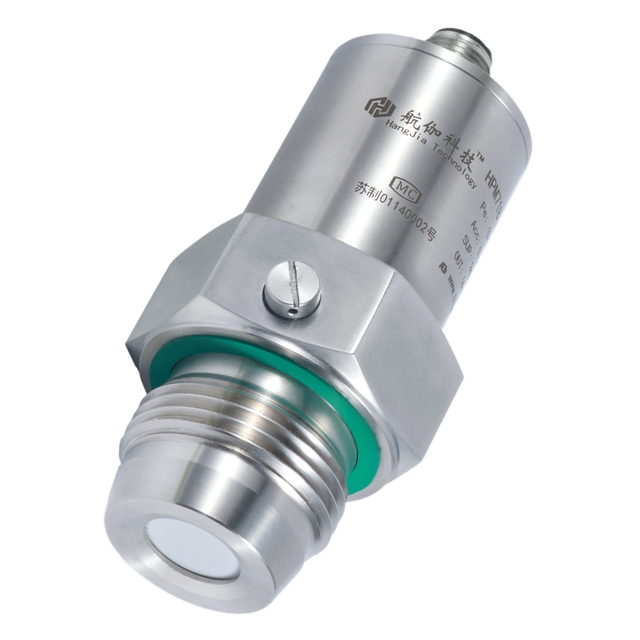
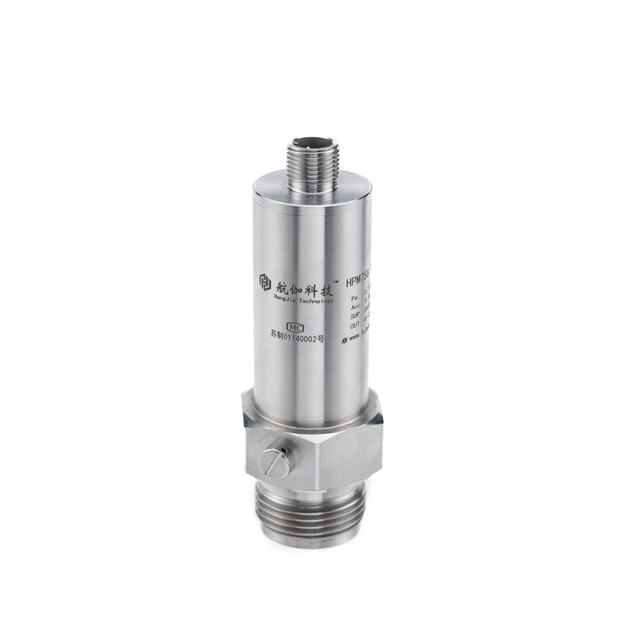
The HPM710 uses a silicon pressure core with a 316L stainless steel flush diaphragm. The measuring end is compact and robust, with standard silicone oil or olive oil as the pressure transmission medium. Optional cooling fins allow media temperatures up to higher ranges. This model is ideal for viscous, scaling, or easily blocked media in food, dairy, and pharmaceutical plants.
Best when you need:
A rugged, all‑316L flush diaphragm transmitter.
Gauge, absolute, or sealed gauge pressure from -100 kPa up to 40 MPa.
4‑20 mA, 0‑5/0‑10 V, or RS485 outputs.
Optional cooling fins for hot media (e.g., hot oil, food processing).
Ceramic Capacitive Flat Diaphragm Transmitter (HPM718)
The HPM718 employs a dry ceramic capacitive sensor (Al₂O₃ ≥ 96 %) with no filling oil inside. The flat diaphragm is made of ceramic or 316L, offering excellent corrosion resistance and wear resistance. This transmitter excels at low pressures (down to 2.5 kPa full scale) and has very high overload capability (up to dozens of times the range). It is completely free of oil contamination risk – ideal for oxygen service, ultra‑pure water, and processes that cannot tolerate any oil.
Best when you need:
Oil‑free, dry ceramic sensor for absolute cleanliness.
Micro‑pressure measurement (as low as 0.025 bar / 2.5 kPa).
High overload protection and excellent corrosion resistance.
Food, beverage, and pharmaceutical applications where process contamination must be avoided.
Tri‑Clamp Sanitary Pressure Transmitter (HPM720 / HPM760)
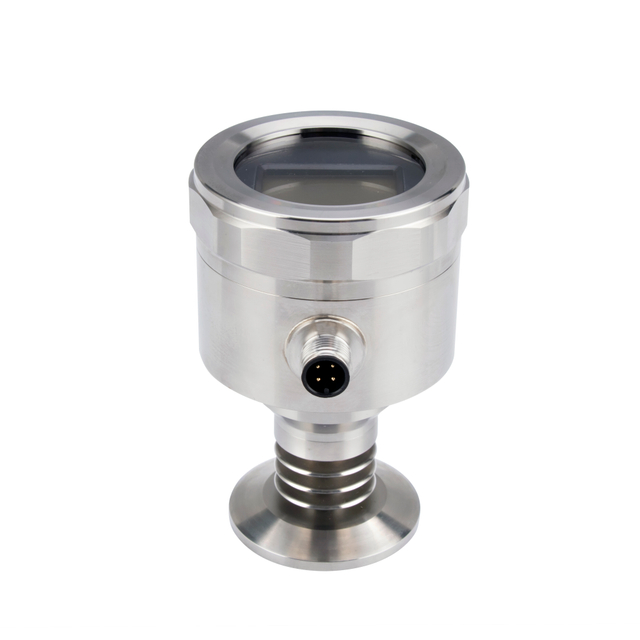
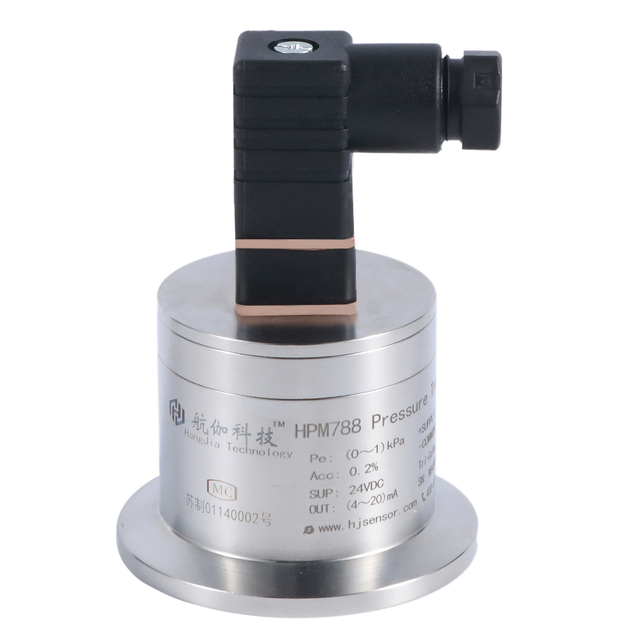
These transmitters are designed for direct mounting on sanitary pipes and vessels via tri‑clamp (DIN 32676, ISO 2852) fittings. The flush diaphragm sits flush with the clamp ferrule, ensuring no product trap. Available with or without integrated LED display (HPM760 offers on‑site digital display). Optional cooling fins (3 or 5 pieces) extend media temperature capability up to 180 ℃. HPM720 supports HART communication; HPM760 adds a local display.
Best when you need:
Standard tri‑clamp connections (1/2", 1", 1‑1/2", 2") for easy integration into existing sanitary lines.
On‑site pressure readout (HPM760) plus remote 4‑20 mA signal.
High‑temperature applications (up to 180 ℃ with cooling fins).
Food, dairy, brewery, and pharmaceutical pressure or level measurement.
Quick comparison
| Model | Sensor technology | Pressure range | Output | Special features |
|---|---|---|---|---|
| HPM710 | Silicon piezoresistive (oil‑filled) | -100 kPa ~ 40 MPa | 4‑20 mA, 0‑5/0‑10 V, RS485 | Cooling fins option, high range |
| HPM718 | Ceramic capacitive (dry) | 0.1 bar ~ 100 bar (down to 2.5 kPa) | 4‑20 mA, 0‑5/0‑10 V, RS485 | Oil‑free, micro‑pressure, high overload |
| HPM720 | Silicon + flush diaphragm | -100 kPa ~ 2.5 MPa | 4‑20 mA, HART, 0‑5/0‑10 V | Tri‑clamp, cooling fins (up to 180 ℃) |
| HPM760 | Silicon + flush diaphragm + display | -100 kPa ~ 2.5 MPa | 4‑20 mA, HART, 0‑10 V | Integral digital display, tri‑clamp |
Sanitary Pressure Transmitter Applications by Industry
Sanitary transmitters are used wherever product purity, cleanability, and regulatory compliance are required.
Food & Beverage
From dairy pasteurizers to brewery fermenters, sanitary transmitters measure pressure for tank level, filter monitoring, and line pressure. Flush diaphragms prevent product buildup, and materials are FDA‑compliant. HPM718 with ceramic sensor is excellent for low‑pressure applications like carbonation monitoring.
Typical uses:
Milk storage tank level.
Beer fermentation vessel pressure.
Syrup and sauce pipeline pressure.
CIP return line pressure monitoring.
Pharmaceutical & Biotech
Bioreactors, fermenters, and sterile filling lines require absolute cleanliness and steam sterilisation. Transmitters must withstand repeated SIP cycles (up to 140 ℃ steam). HPM720 with olive oil fill and 316L diaphragm, or HPM718 dry ceramic, are preferred choices. Tri‑clamp connections allow quick disassembly for autoclaving.
Typical uses:
Bioreactor pressure control.
Sterile water for injection (WFI) loop pressure.
Filter integrity testing (differential pressure).
Cosmetics & Personal Care
Viscous products like creams, lotions, and gels easily clog standard pressure ports. Flat diaphragm transmitters (HPM710, HPM718) mounted with a flush or extended membrane prevent clogging and are easy to clean between batch changes.
How to Choose the Right Sanitary Pressure Transmitter
Pressure Range & Overload
Select a range where normal operating pressure sits between 30% and 80% of full scale. For low pressures (< 100 mbar), a dry ceramic sensor (HPM718) provides better resolution and overload protection. For high pressures (up to 40 MPa), HPM710 with silicon core is suitable.
Process Connection
Sanitary applications almost always require a hygienic fitting:
Tri‑clamp (clamp fitting) – most common. Sizes: 1/2", 1", 1‑1/2", 2". Standards: ISO 2852, DIN 32676, 3‑A.
DIN 11851 (threaded union) – used in European dairy and pharmaceutical plants.
SMS (Swedish standard) – for some food lines.
Varivent – for aseptic applications.
Ensure the transmitter’s flush diaphragm matches the fitting type and size of your vessel or pipe.
Wetted Materials & Fill Fluid
Diaphragm material – 316L stainless steel is standard. For highly corrosive media, Hastelloy C or Tantalum is available.
Fill fluid – standard silicone oil works for most applications. For food/pharma where accidental leakage could occur, use olive oil (FDA‑compliant) or other food‑grade fill fluids. Dry ceramic sensors (HPM718) eliminate the need for any fill fluid.
Temperature & Cleaning Compatibility
If the process involves hot media or CIP/SIP cycles, consider:
Without cooling fins – media temperature up to 80 ℃ (HPM720/760) or 100 ℃ (HPM718).
With cooling fins – 3 fins up to 140 ℃, 5 fins up to 180 ℃ (HPM720/760). HPM710 can be customised for higher temperatures.
Ensure the transmitter’s electronics are kept within ambient limits by using a cooling fin or remote mount.
Output Signal
4‑20 mA – industry standard, suitable for long cable runs.
4‑20 mA + HART – allows digital configuration and diagnostics.
0‑5/0‑10 V – for short runs and voltage‑input controllers.
RS485 / Modbus – for digital networks.
Local Display
For applications where operators need to see pressure on‑site (e.g., tank farm, filter skid), choose a model with an integral display like HPM760.
Sanitary Pressure Transmitter FAQs
What makes a pressure transmitter “sanitary”?
A sanitary pressure transmitter has a flush or planar diaphragm that sits flush with the process connection, leaving no cavities, threads, or dead spaces where product or bacteria can accumulate. It is made of corrosion‑resistant materials (typically 316L stainless steel) with a smooth surface finish (Ra ≤ 0.8 µm). It must be compatible with CIP and SIP cleaning procedures and often carries 3‑A, FDA, or EHEDG certifications.
Can I use a standard industrial pressure transmitter in a food plant?
No – standard transmitters have threaded pressure ports with dead volumes where product can lodge and spoil, leading to contamination and failed audits. Always use a true sanitary flush‑diaphragm transmitter for food contact applications.
What is the difference between HPM710 and HPM718?
HPM710 uses a silicon piezoresistive sensor with oil fill. It offers higher pressure ranges (up to 40 MPa) and is very robust. HPM718 uses a dry ceramic capacitive sensor – no oil fill – which is ideal for very low pressures (down to 2.5 kPa), high overload, and applications where oil contamination is unacceptable (e.g., oxygen, ultra‑pure water).
Do I need cooling fins?
If your media temperature exceeds the transmitter’s ambient rating (typically 85 ℃), you need cooling fins. For media up to 140 ℃, use 3 fins; up to 180 ℃, use 5 fins. The fins dissipate heat before it reaches the electronics. Without fins, electronics can overheat and drift or fail.
How do I clean a sanitary pressure transmitter?
Most sanitary transmitters are designed for clean‑in‑place (CIP). The smooth diaphragm and hygienic fitting allow cleaning solution to flow across the surface without removing the transmitter. Always follow the manufacturer’s recommendations for temperature, pressure, and cleaning agent compatibility. For SIP (steam sterilisation), ensure the transmitter is rated for the required steam temperature and duration.
What output should I choose for a new sanitary installation?
4‑20 mA is the most common because it is noise‑immune and works over long distances. If you need remote configuration or diagnostic data, choose 4‑20 mA + HART. For a local operator interface, consider a transmitter with an on‑board display (HPM760).
Why Choose Our Sanitary Pressure Transmitters?
We design and manufacture sanitary pressure transmitters specifically for the food, beverage, pharmaceutical, and biotech industries. Every model is built with hygienic principles at the core.
True Flush Diaphragm Design
Our transmitters feature planar diaphragms that are laser‑welded to the process connection, leaving no gaps or crevices. Surfaces are electropolished (optional) to improve cleanability and corrosion resistance.
Material Traceability & Compliance
All wetted parts are 316L stainless steel, with material certificates available upon request. Fill fluids include standard silicone oil, olive oil (FDA), or oil‑free ceramic options. We support 3‑A and EHEDG requirements for qualified installations.
Flexible Process Connections & Outputs
Tri‑clamp (all standard sizes), DIN 11851, SMS, and custom flanges. Outputs: 4‑20 mA, HART, 0‑10 V, RS485. Integral displays, cooling fins, and cable lengths can be configured per your order.
Fast Support & Customisation
We understand that sanitary processes vary widely. Our engineering team helps you select the right diaphragm material, fill fluid, process connection, and electrical interface for your specific application – whether it’s a low‑pressure CIP return line or a high‑pressure homogeniser.
What you get:
Application‑specific advice from experienced sanitary process engineers.
Quick turnaround on custom configurations (special diaphragms, extended temperature ranges).
Full documentation for regulatory files (certificates, test reports).