Industrial Temperature Sensor




Industrial Temperature Sensor
Temperature is one of the most critical process variables – too high and you risk equipment failure or product spoilage, too low and efficiency drops. A failed temperature sensor can go unnoticed until a batch is ruined or a machine overheats.
Here you'll discover industrial temperature sensors for gas, liquid, steam and solids – from platinum resistance thermometers (RTDs) and thermocouples to bimetal thermometers and digital temperature gauges with on‑site display.
On this page, we help you choose the right sensing element, connection type, and installation method so your process stays within safe limits and your product quality remains consistent.
What Is an Industrial Temperature Sensor?
An industrial temperature sensor converts thermal energy into a readable signal – either a resistance value (RTD), a voltage (thermocouple), or a mechanical pointer movement (bimetal). It allows operators and control systems to monitor, log, and react to temperature changes in real time.
Most industrial temperature measurement relies on two principles:
Resistance Temperature Detectors (RTD) – typically platinum (Pt100 or Pt1000). As temperature rises, the electrical resistance of the metal increases in a predictable way. RTDs offer high accuracy, stability, and repeatability over a wide range (-200 °C to +500 °C). They are the first choice for most industrial processes.
Thermocouples – two dissimilar metals joined at one end produce a small voltage proportional to temperature. They are rugged, fast, and suitable for very high temperatures (up to 1200 °C or more), but less accurate than RTDs.
Bimetal thermometers – a mechanical device using two strips of different metals bonded together. As temperature changes, the differential expansion causes the pointer to move. No power supply needed, simple and reliable for local indication.
Types of Industrial Temperature Sensors We Offer
Our temperature sensor portfolio covers multiple sensing technologies and form factors, from simple bimetal thermometers to intelligent digital gauges with data logging.
Platinum Resistance Thermometer (RTD) – WZ Series
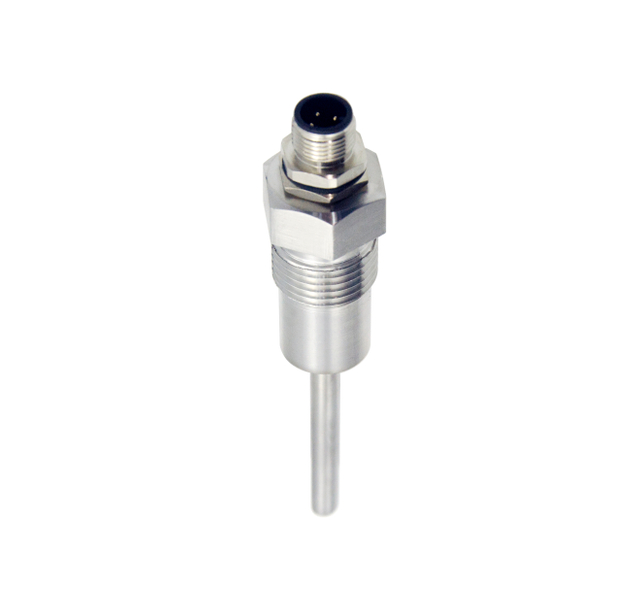
The WZ series industrial thermal resistance sensors use high‑quality Pt100 or Cu50 elements. They are typically installed inside a stainless steel protection tube, making them suitable for liquid, gas, steam, and even solid surface measurement. Available in various diameters and lengths, with options for Class A or Class B accuracy.
Best when you need:
Stable, accurate measurement from -200 °C up to 500 °C.
Interchangeability with standard Pt100 instruments (no cold‑junction compensation).
Robust protection tube (316L stainless steel) for pressure and corrosion resistance.
2‑wire, 3‑wire, or 4‑wire connection to eliminate lead resistance errors.
Bimetal Thermometer – HTB Series
The HTB bimetal thermometer is a purely mechanical, mercury‑free temperature indicator. It uses a helical bimetal strip that rotates a pointer on a dial. No batteries, no wiring – just a direct local reading. Available in axial, radial, and universal mounting styles, with dial sizes from 63 mm to 100 mm and temperature ranges up to 600 °C.
Best when you need:
Simple, reliable local temperature indication without power.
Easy reading at a distance – large dial with dual °C/°F scale.
Vibration‑resistant design – optional glycerin filling for damping.
No maintenance, long service life.
Digital Temperature Gauge – HTE80
The HTE80 is a battery‑powered digital thermometer with a large 5‑digit LCD display. It uses a Pt100 or Pt1000 sensor and features a high‑accuracy conditioning circuit. Additional functions include peak/valley recording, backlight, auto power off, and a simulation bar graph. It is housed in a stainless steel case and can be fitted with various process connections.
Best when you need:
High‑resolution digital readout on site (up to 5 digits).
Data hold, min/max memory, and adjustable acquisition rate.
Long battery life (≥ 6 months with typical use).
A direct replacement for analog gauges where digital precision is desired.
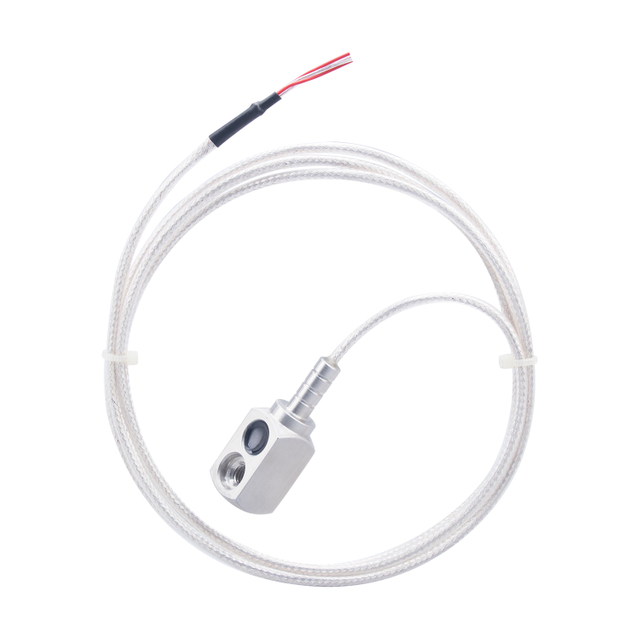
Surface Temperature Sensor – HTP150
Designed for measuring the surface temperature of motors, reducers, pipes, and machinery housings. The HTP150 uses a Pt100 element in a compact, bolt‑down enclosure. It is passive (no external power) and outputs a resistance signal compatible with 2‑, 3‑, or 4‑wire instruments.
Best when you need:
Surface mounting – direct contact with flat or curved surfaces.
Use in confined spaces (45 × 16 × 16 mm).
Intrinsically safe or mining environments (no internal electronics).
Simple retrofit with existing Pt100 input cards.
Quick comparison
| Sensor type | Technology | Temperature range | Output / display | Best for |
|---|---|---|---|---|
| WZ RTD (thermal resistance) | Pt100 / Cu100 | -200 °C ~ 500 °C | Resistance (100 Ω at 0 °C) | Pipelines, tanks, reactors – high accuracy |
| HTB bimetal thermometer | Bimetal strip | -50 °C ~ 600 °C | Analog dial | Local reading, no power, low cost |
| HTE80 digital gauge | Pt1000 + electronics | -50 °C ~ 500 °C | 5‑digit LCD + backlight | Digital on‑site display, data logging |
| HTP150 surface sensor | Pt100 | 0 °C ~ 200 °C | Resistance | Machinery, motor windings, confined spaces |
Industrial Temperature Sensor Applications by Industry
Chemical & Petrochemical
Reactors, distillation columns, and storage tanks require reliable temperature monitoring for process control and safety. WZ series RTDs with stainless steel protection tubes and flanged connections are commonly used. For high‑temperature zones (above 400 °C), thermocouples can be supplied on request.
HVAC & Building Automation
Air handling units, chillers, and boiler systems need temperature sensors for energy management. HTE80 digital gauges provide easy on‑site reading for maintenance teams, while Pt100 sensors transmit to BMS controllers.
Machinery & Equipment Monitoring
Bearings, gearboxes, and hydraulic oil reservoirs – surface temperature sensors (HTP150) are bolted directly onto the housing to detect overheating before failure. The 4‑wire Pt100 output can be connected to a PLC or a local alarm.
Food & Pharmaceutical
Sanitary requirements demand smooth, crevice‑free fittings. We offer RTDs with tri‑clamp connections and 316L sheaths. Digital temperature gauges (HTE80) with stainless steel housing and hygienic process connections are available upon request.
How to Choose the Right Industrial Temperature Sensor
Sensing Element & Temperature Range
Pt100 (class A or B) – best for most industrial processes from -200 °C to 500 °C. High accuracy and long‑term stability.
Thermocouple (Type K, J, etc.) – for very high temperatures (>500 °C) or fast response. Lower initial accuracy but wide range.
Bimetal – for local indication only, where no electronic signal is needed.
Pt1000 – used in digital gauges (HTE80) for higher sensitivity.
Process Connection & Installation
Threaded – G1/2, M20×1.5, NPT for direct insertion into pipes or tanks.
Flanged – for larger vessels or corrosive media.
Tri‑clamp – for sanitary applications.
Surface mount – HTP150 style for bolt‑on attachment.
Output & Display
Resistance (Pt100) – for connection to PLCs, transmitters, or digital indicators.
Analog dial – bimetal for local reading only.
Digital LCD – battery‑powered for on‑site reading with additional features (backlight, min/max).
Protection & Environment
Ingress protection – IP54 for most digital gauges, higher on request.
Vibration resistance – bimetal thermometers with glycerin filling or RTDs with robust sheath.
Corrosive media – use 316L stainless steel or Inconel protection tube.
Industrial Temperature Sensor FAQs
What is the difference between a Pt100 RTD and a thermocouple?
A Pt100 RTD provides a highly stable, linear resistance output. It is more accurate and repeatable than a thermocouple but has a lower maximum temperature (typically 500 °C). A thermocouple is more rugged, faster responding, and can measure up to 1200 °C or more, but with lower accuracy and the need for cold‑junction compensation.
Do I need a 2‑wire, 3‑wire, or 4‑wire connection for my RTD?
2‑wire – simple and low cost, but lead resistance adds error. Suitable for short distances and low accuracy requirements.
3‑wire – cancels most lead resistance errors. The most common industrial connection.
4‑wire – highest accuracy, used in laboratories and calibration. Our RTDs (WZ series) and surface sensors (HTP150) can be wired in any of these configurations.
Can I replace a bimetal thermometer with a digital temperature gauge?
Yes – if you have a threaded thermowell, you can remove the bimetal thermometer and install an HTE80 digital gauge with the same process connection. The digital gauge provides better readability, higher accuracy, and additional functions like peak recording and backlight. However, it requires a battery (replaceable) and electronic components that may have a shorter life in very harsh environments compared to a purely mechanical bimetal.
How often should temperature sensors be calibrated?
For RTDs used in critical processes (e.g., chemical reactors), calibration every 12 months is typical. For less critical monitoring (e.g., HVAC), every 2‑3 years may be sufficient. Bimetal thermometers are usually checked against a reference – they do not drift much but can be damaged mechanically.
What is the maximum temperature for the WZ series RTD?
The standard WZ series with 316L protection tube is rated from -200 °C to 500 °C. For higher temperatures, we offer thermocouple assemblies. For cryogenic applications, special designs are available.
Why Choose Our Industrial Temperature Sensors?
We offer a complete range of temperature measurement technologies – from reliable Pt100 RTDs and bimetal thermometers to intelligent digital gauges. Every sensor is built for industrial conditions, not just a lab environment.
Quality & Reliability
High‑grade Pt100 elements (Class A or B) for stable, repeatable readings.
All wetted parts in stainless steel (304 or 316L) for corrosion resistance.
Rigorous testing and long‑term ageing verification.
Flexibility
Multiple sensing elements (Pt100, Pt1000, Cu50, thermocouple).
Wide choice of process connections: threaded, flange, tri‑clamp, surface mount.
Custom insertion lengths, protection tube diameters, and thermowells.
Easy to Specify & Install
Clear ordering codes for RTD assemblies – choose element, sheath material, length, connection head, and output.
Bimetal thermometers available in axial, radial, and universal mounting.
Digital gauges come fully configured, ready to install.
Fast Support & Customisation
We help you select the right sensor for your temperature range, media, and environment. For OEM or project orders, we can customise immersion lengths, labelling, and electrical terminations.