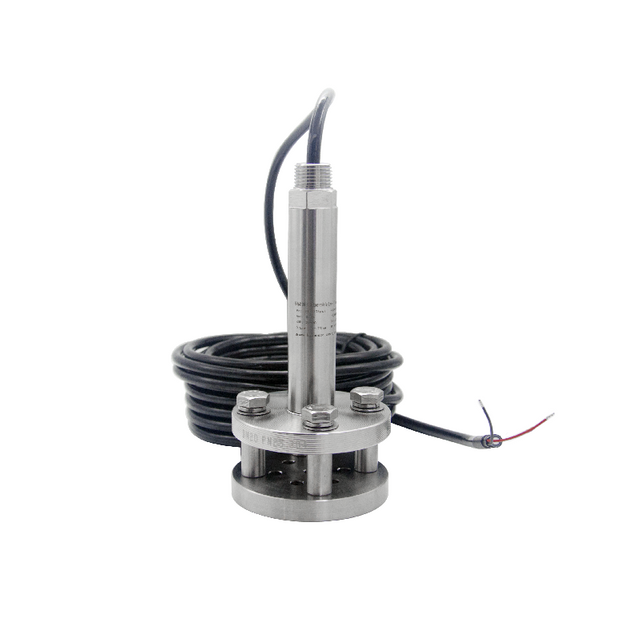
Accurate level measurement in tanks, wells, rivers, and lift stations is essential for process control, environmental monitoring, and water management. A failed level transmitter can lead to overflowing tanks, dry‑running pumps, or inaccurate inventory.
Here you'll discover submersible level transmitters for water, wastewater, seawater, and corrosive liquids – from general purpose models to mini‑diameter, anti‑sand, anti‑weed, and ceramic capacitive versions. On this page, we help you choose the right measuring range, output signal, cable material, and mounting accessories so your level monitoring is reliable, even in harsh conditions.
A submersible level transmitter (also called a hydrostatic level probe) measures the hydrostatic pressure exerted by a liquid column above it. The pressure is directly proportional to the liquid height (level) when the liquid density is known. The transmitter is lowered into the tank, well, or open channel and is completely sealed against the environment.
Inside, a pressure sensor – typically a silicon piezoresistive or ceramic capacitive element – converts the hydrostatic pressure into an electrical signal. A vented cable allows atmospheric pressure to reach the back of the sensor, so the output is true gauge pressure (i.e., only the liquid column, unaffected by barometric changes). The signal conditioning circuit then outputs a standard 4‑20 mA, 0‑10 V, or RS485 signal to a controller or display.
Because the entire assembly is potted and welded, it can be submerged continuously at depths up to 500 meters or more.
The pressure at the bottom of a liquid column is: P = ρ × g × h, where:
P = hydrostatic pressure (Pa)
ρ = liquid density (kg/m³)
g = gravitational acceleration (≈9.81 m/s²)
h = liquid height (m)
The transmitter measures P, and with known density, the level (h) is calculated. Most submersible level transmitters are factory calibrated in meters of water column (mH₂O) or feet of water (ftH₂O). For liquids with different densities (e.g., fuel, chemicals), the transmitter can be calibrated accordingly or the density factor applied in the control system.
Our submersible level transmitter portfolio covers a wide range of applications – from clean water in deep wells to aggressive sewage and coastal seawater.
The HPM410 is the workhorse of submersible level measurement. It uses a silicon piezoresistive pressure sensor, fully welded 316L stainless steel housing, and a double‑sealed, potted construction. The vented cable is available in polyurethane (PU) or nitrile (NBR) jacket. Ranges from 1 to 500 mH₂O with typical accuracy of ±0.5% FS (optional ±0.2% FS). Wide temperature compensation and multiple outputs (4‑20 mA, HART, RS485, relay) make it suitable for most industrial and municipal applications.
Best when you need:
A robust, all‑stainless steel submersible probe.
IP68 protection for continuous immersion.
Level measurement in water tanks, rivers, lift stations, and groundwater wells.
Output options: 4‑20 mA (2‑wire), 0‑10 V, RS485, or HART.
The HPM420W separates the sensing probe (submersible) from the electronics housing (top‑side). The probe contains the pressure sensor and is fully sealed to IP68. A junction box with a local display and configuration buttons is mounted above ground, making set‑up and reading easy without pulling the probe out of the well. Ideal for deep wells, reservoirs, and sites where on‑site indication is required.
Best when you need:
Local display of level value at ground level.
Probe depth up to 300 mH₂O.
Easy calibration without lifting the probe.
4‑20 mA, HART, RS485, or relay outputs.
Designed for narrow boreholes, small pipes, or restricted access points, the HPM4119 has an ultra‑slim 19 mm diameter probe. Despite its small size, it offers high accuracy (up to ±0.1% FS) and ranges up to 350 mH₂O. The fully welded 316L housing and PU or NBR cable ensure long‑term reliability.
Best when you need:
Insertion through a very small opening (e.g., 1‑inch borehole).
High accuracy for groundwater monitoring or laboratory applications.
Low‑voltage (2.8~5.5 V) options for battery‑powered dataloggers.
In rivers, lakes, and coastal waters, sand, silt, and aquatic plants can clog or damage a standard submersible probe. The HPM410‑C features a customised filter ring (316L or ceramic) that prevents particulate ingress and stops waterweed from wrapping around the diaphragm. The filter ring is removable and cleanable. This model is built for challenging environments with high sediment or biological growth.
Best when you need:
Protection against sand, debris, and algae.
Long‑term deployment in rivers, reservoirs, or cooling water intakes.
316L probe plus optional ceramic filter ring.
For corrosive media (seawater, chemicals, wastewater with high salinity) or where long‑term reliability is critical, the HPM47W‑CSN uses a 99.9% Al₂O₃ ceramic capacitive sensor. The all‑316L or titanium alloy probe and fluoroplastic (FEP) cable provide excellent resistance to chemicals, salt, and UV. The dry ceramic sensor (no oil fill) means no contamination risk and very high overload capability.
Best when you need:
Corrosion resistance – seawater, chemical plants, wastewater treatment.
High overload protection (up to 600 kPa for a 10 kPa sensor).
Oil‑free measurement for ultrapure or sensitive applications.
Accuracy as good as ±0.25% FS.
Quick comparison
| Model | Probe diameter | Pressure range | Sensor technology | Output | Special feature |
|---|---|---|---|---|---|
| HPM410 | ~27 mm | 1 ~ 500 mH₂O | Silicon piezoresistive (316L) | 4‑20 mA, HART, RS485, relay | General purpose, IP68 |
| HPM420W | Probe + junction box | 1 ~ 300 mH₂O | Silicon piezoresistive (316L) | 4‑20 mA, HART, RS485 | Top‑side display, split type |
| HPM4119 | 19 mm | 1 ~ 350 mH₂O | Silicon piezoresistive | 4‑20 mA, 0‑10 V, RS485, low voltage | Mini‑diameter, high accuracy |
| HPM410‑C | ~27 mm with filter | 1 ~ 500 mH₂O | Silicon piezoresistive (316L) | 4‑20 mA, HART, RS485 | Anti‑sand & waterweed filter ring |
| HPM47W‑CSN | ~27 mm | 0.5 ~ 400 mH₂O (0~40 mH₂O typical) | Ceramic capacitive (Al₂O₃) | 4‑20 mA, HART, RS485 | Corrosion resistance, oil‑free |
Lift stations, pump control, storage tanks, and open channels. A submersible level transmitter directly senses the water level and can start/stop pumps via relay output or send a 4‑20 mA signal to a PLC. The HPM410 (general) and HPM420W (with display) are common choices. For wastewater with debris, the HPM410‑C with filter ring prevents clogging.
Environmental monitoring of aquifers, boreholes, and remediation wells. Mini‑diameter probes (HPM4119) fit into narrow well casings. High accuracy (±0.1% FS) is available for precise water table tracking. Long‑term stability is essential for multi‑year deployments.
Seawater level, tide monitoring, and ship ballast tanks require corrosion‑resistant materials. The HPM47W‑CSN with titanium probe and fluoroplastic cable resists saltwater corrosion. Ceramic capacitive sensors are unaffected by salt residue.
Acid, alkali, solvent, or ultrapure water level measurement. Choose the HPM47W‑CSN with ceramic sensor (no oil) and PTFE/Teflon cable. Wetted materials can be specified to match the chemical compatibility.
Rivers, canals, and reservoirs often have sand, mud, and aquatic growth. The HPM410‑C anti‑sand & waterweed design keeps the diaphragm clear. The filter ring can be easily removed for cleaning.
Select a range where the maximum expected level is between 70% and 100% of the transmitter’s full scale. Do not oversize – a 20 mH₂O transmitter on a 2 m tank will have poor resolution. Typical ranges: 1 m, 2 m, 5 m, 10 m, 20 m, 50 m, 100 m, up to 500 m.
Polyurethane (PU) – good for fresh water, wastewater, and general use; abrasion‑resistant.
Nitrile (NBR) – oil‑resistant; suitable for oily water or fuel.
Fluoroplastic (FEP/PFA) – excellent chemical resistance for aggressive liquids (acids, solvents).
Cable length should be ordered at least 1–2 m longer than the maximum water depth to allow slack and surface termination.
Silicon piezoresistive (316L diaphragm) – general purpose, good accuracy, cost‑effective.
Ceramic capacitive (Al₂O₃) – excellent corrosion resistance, high overload, oil‑free, but more expensive.
4‑20 mA (2‑wire) – most common, loop‑powered, immune to long cable runs.
0‑10 V (3‑wire) – for short runs and voltage‑input controllers.
RS485 / Modbus – digital communication, multi‑drop network, can also output temperature (on some models).
Relay output – direct pump control (e.g., HPM410 with relay option).
Threaded mounting part (W1) – for attaching the probe to a fixed pipe or bracket.
Cable clip (W8) – secures the cable at the top of the tank or well.
Right‑angle mounting bracket (W4) – for wall mounting.
Heavy hammer (W2 top or W3 bottom) – keeps the probe submerged and vertical in flowing water.
Protective tube – for turbulent or high‑flow environments.
A submersible level transmitter is designed for continuous immersion. It has a water‑tight, potted, and welded housing (IP68), a vented cable that allows atmospheric reference, and often a nose cone or filter to protect the diaphragm. A standard pressure transmitter may only be IP65/IP67 and is not intended for permanent underwater use.
Yes for most submersible level applications. The vented cable allows the back of the sensor to reference atmospheric pressure, so the output truly reflects the hydrostatic pressure of the liquid column, independent of barometric changes. Unvented (absolute) sensors would need real‑time barometric compensation. Our submersible transmitters use vented cables with a desiccant‑filled vent tube to prevent moisture ingress.
Secure the cable at the top of the tank/well using a cable clip or mounting bracket. Do not let the cable bear the full weight of the probe – use a strain relief or cable clamp.
Lower the probe gently to the desired depth (usually the lowest level you want to measure).
For flowing water or large tanks, use a heavy hammer (bottom weight) or protective tube to keep the probe in place and prevent movement.
Connect the signal wires to your controller or display. For 4‑20 mA loop‑powered, connect the red wire to +V (e.g., 24 V) and black wire to the input of your controller (which goes to ground).
Keep the vent tube (inside the cable) open and dry – do not allow water to enter the breather plug at the top end.
Water in the vent tube will block the atmospheric reference, causing erroneous readings and possibly damaging the sensor. Always keep the vented cable’s breather cap dry and above the potential water level. For outdoor installations, protect the cable end from rain and condensation.
Yes. The transmitter is factory calibrated in meters of water (ρ≈1000 kg/m³). For a liquid with density D (kg/m³), the actual level = (water equivalent range) × (1000/D). Alternatively, we can custom‑calibrate the transmitter for your specific liquid density. Contact us for special calibrations.
For municipal and industrial applications, every 12–24 months is typical. For environmental monitoring, every 2–3 years may be sufficient. Our transmitters have long‑term stability of ±0.2% FS/year. If readings drift beyond expected, check for diaphragm fouling, vent tube blockage, or cable damage before recalibrating.
We design and manufacture submersible level transmitters that survive real‑world conditions – deep wells, muddy rivers, corrosive tanks, and turbulent pump stations. Every probe is fully welded, pressure‑tested, and 100% electrically tested before shipping.
Fully welded 316L stainless steel or titanium probe – no seals to leak.
Multiple cable options – PU, NBR, fluoroplastic for every environment.
Double‑sealed, full potting – IP68 protection for continuous submersion.
Desiccant‑filled vent tube – keeps moisture out of the reference air path.
Ranges from 1 mH₂O up to 500 mH₂O.
Accuracy: ±0.5% FS standard, ±0.2% FS or ±0.1% FS optional.
Temperature compensation from -10 °C to +80 °C.
Mini‑diameter (19 mm) for narrow boreholes.
Anti‑sand & waterweed with removable filter ring.
Ceramic capacitive for aggressive and corrosive media.
Split‑type with display for easy on‑site reading.
We supply threaded mounting parts, cable clips, brackets, heavy hammers, protective tubes, and IP68 junction boxes – everything you need for a professional installation.
Our engineering team helps you select the correct range, cable length, output signal, and mounting accessories. For special liquids, we can custom‑calibrate to any density. For OEM or project orders, we offer custom probe lengths, customer‑specific cables, and special markings.