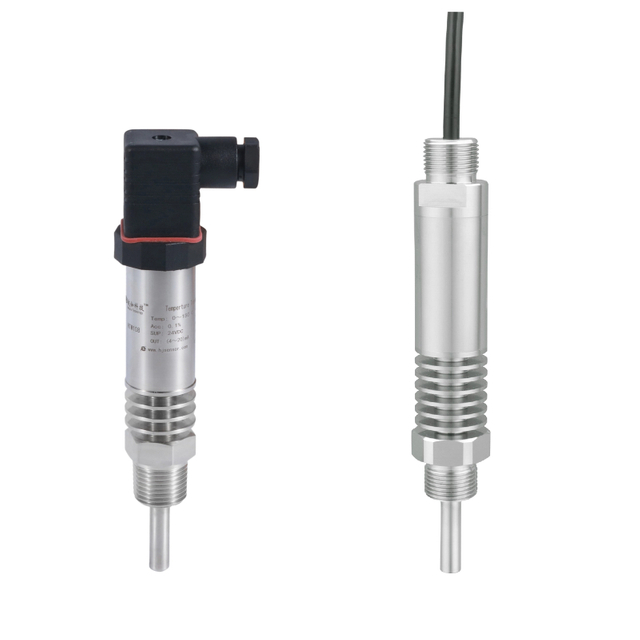
RTD Temperature Transducers Vs. Thermocouples: Choosing The Right Sensor for Your Process
Views: 122 Author: Site Editor Publish Time: 2025-09-01 Origin: Site
Temperature measurement is a cornerstone of industrial operations. From controlling chemical reactions to ensuring food safety, accurate temperature monitoring ensures that processes run smoothly, products meet quality standards, and safety risks are minimized. Among the most common temperature-sensing technologies, RTD (Resistance Temperature Detector) temperature transducers and thermocouples stand out for their wide usage across industries. While both serve the same core purpose—measuring temperature—they differ significantly in terms of design, operation, performance characteristics, and ideal applications. Understanding these differences can make all the difference in selecting the right sensor for your process.
Understanding RTD Temperature Transducers
An RTD temperature transducer measures temperature based on the principle that the electrical resistance of certain metals changes predictably with temperature. In most industrial RTDs, the sensing element is made of pure platinum, which offers stability, repeatability, and accuracy. Platinum RTDs, such as the well-known PT100 type, provide resistance of 100 ohms at 0°C, with a standardized resistance change per degree of temperature.
The RTD element is often encased in protective sheaths made of stainless steel or other corrosion-resistant materials. These elements are connected to a transducer, which converts the resistance signal into a usable electrical output, often a 4–20 mA analog signal for industrial control systems. This allows seamless integration into process control loops.
The key strength of RTDs lies in their accuracy and stability over time. With minimal drift, they can provide reliable measurements for years, making them well-suited for applications where consistent precision is crucial.
Understanding Thermocouples
Thermocouples operate on a different principle, using the Seebeck effect. This phenomenon occurs when two dissimilar metals are joined at one end and exposed to a temperature difference between the joined end (measuring junction) and the other ends (reference junctions). The resulting voltage generated is proportional to the temperature difference.
Thermocouples come in many types, such as Type K, J, T, and E, each with specific temperature ranges and characteristics. They are known for their wide operating temperature ranges, with some capable of measuring extremely high temperatures beyond what RTDs can handle. They are also rugged and fast-responding, making them ideal for dynamic or harsh environments.
Unlike RTDs, thermocouples require reference junction compensation and may need more frequent calibration due to drift over time, particularly in high-temperature applications.
Comparing Accuracy
One of the most important differences between RTD temperature transducers and thermocouples is accuracy. RTDs generally offer higher accuracy, often within ±0.1°C to ±0.5°C depending on the design and quality. This level of precision is why RTDs are common in laboratories, pharmaceutical manufacturing, and other high-specification industries.
Thermocouples, while less accurate, still provide sufficient precision for many industrial needs. Their typical accuracy is within ±1°C to ±2°C, but this can vary based on type, installation, and calibration frequency. For processes where small deviations are acceptable, thermocouples remain a practical choice.
Response Time and Dynamic Conditions
Thermocouples usually have faster response times than RTDs because their sensing junction is small and can be exposed directly to the medium. This allows them to capture rapid temperature changes in processes like combustion monitoring or turbine exhaust measurement.
RTDs, with their more robust construction, tend to have slightly slower response times. While they can still react quickly enough for most applications, they may not be the first choice in situations where instantaneous measurement is critical.
Durability and Temperature Range
When it comes to extreme temperatures, thermocouples have a clear advantage. Certain types can measure temperatures above 1700°C, making them suitable for metal forging, kiln operations, and high-temperature chemical processing. RTDs typically operate up to about 600°C to 850°C, depending on the materials used.
In terms of durability, thermocouples are generally more tolerant of vibration and mechanical shock, while RTDs are more sensitive and can be damaged by rough handling. However, RTDs excel in long-term stability and resistance to drift, especially at lower temperatures.
Stability and Long-Term Reliability
Over the long term, RTDs maintain their calibration better than thermocouples. Drift in RTDs is minimal when operated within their temperature limits, meaning they require less frequent recalibration. This makes them cost-effective for applications where maintenance access is difficult.
Thermocouples, on the other hand, may degrade over time due to oxidation, contamination, or changes in the metal junctions. In high-temperature environments, drift can occur quickly, requiring periodic recalibration or replacement.
Cost Considerations
Cost often influences sensor choice. Thermocouples are generally less expensive to purchase, especially in basic forms. They are a good fit for budget-sensitive projects, short-term applications, or scenarios where sensors may need frequent replacement due to harsh conditions.
RTDs, with their precision manufacturing and materials like platinum, tend to cost more upfront. However, their long service life and reduced calibration requirements can lead to lower total ownership costs over time.
Application Scenarios
In water tank temperature monitoring, RTDs are often favored for their stability and accuracy, ensuring consistent readings for process control or safety monitoring. In power plants, the choice depends on the specific location—RTDs for precise monitoring in control rooms and thermocouples for extreme heat measurement in turbines.
Kiln temperature measurement is an area where thermocouples excel due to their ability to withstand intense heat and rapid temperature changes. Steam temperature monitoring can use both technologies, with RTDs providing reliable readings for system efficiency tracking and thermocouples handling more variable or extreme steam conditions.
In distillation columns, where accurate temperature gradients are vital to separating components effectively, RTDs are often the preferred choice due to their precision. Thermocouples may be used in supporting roles where broader temperature ranges or faster responses are needed.
Integration with Control Systems
Modern RTD temperature transducers often output standardized signals like 4–20 mA or digital protocols such as HART, making them easy to integrate into PLCs, SCADA systems, and distributed control systems. Thermocouples require signal conditioning and cold junction compensation, which can be handled by specialized transmitters or modules.
When evaluating integration, it’s important to consider the compatibility of the sensor with existing infrastructure, as well as the need for transmitters, wiring complexity, and signal stability over long cable runs.
Choosing the Right Sensor for Your Process
Selecting between an RTD temperature transducer and a thermocouple comes down to balancing accuracy, temperature range, response time, durability, and cost. If your process demands high accuracy, long-term stability, and operates within moderate temperature ranges, an RTD is often the better option. If your process involves very high temperatures, requires ruggedness, or needs rapid response, a thermocouple may be more suitable.
It’s also worth considering the total lifecycle cost, including purchase price, calibration intervals, maintenance, and expected lifespan. In many facilities, a combination of both sensor types is used to meet the diverse needs of different process areas.
Conclusion
RTD temperature transducers and thermocouples each have unique strengths that make them suitable for specific roles in industrial temperature measurement. RTDs offer superior accuracy and stability, making them ideal for precision-critical applications. Thermocouples provide versatility, durability, and the ability to measure extreme temperatures, making them indispensable in harsher environments. By understanding the capabilities and limitations of each technology, engineers and process managers can make informed decisions that optimize performance, reliability, and cost-effectiveness in their operations. The right choice not only ensures accurate temperature data but also supports smoother processes, better product quality, and greater operational safety.
Related News
content is empty!