
Can a Sanitary Pressure Transmitter Measure Low Pressure?
Views: 0 Author: Site Editor Publish Time: 2026-09-30 Origin: Site
Measuring slight pressure changes without risking hygiene is a massive headache for plant operators. You face a constant dilemma. Do you prioritize capturing extremely subtle pressure variations, or do you strictly adhere to sanitary compliance?
The core question is straightforward. Can a hygienic instrument actually capture these micro-variations? Yes. A specialized device handles low pressure effectively. But it requires highly specific sensor designs and precise mechanical engineering.
In this engineering guide, you will discover how advanced ceramic sensors, flat membranes, and smart selection criteria come together to solve this complex industrial hurdle.
Key Takeaways
Specialized Technology is Mandatory: Standard industrial transmitters struggle with low-pressure ranges. Capturing micro-pressure accurately requires advanced capacitive or piezoresistive technologies tailored specifically for sanitary pipelines.
Ceramic Sensors Dominate: High-purity ceramic elements provide exceptional sensitivity, inherent corrosion resistance, and robust physical overpressure protection.
Flush Diaphragms Prevent Contamination: Implementing a flat, crevice-free design ensures the complete elimination of dead legs where bacteria proliferate. It maintains the ultra-thin membrane required to detect minute shifts.
Broad Field Applications: Precision instruments are critical for bioreactor liquid level monitoring, cleanroom environmental control, and filtration system diagnostics.
Total Cost of Ownership: Balancing initial price against long-term performance is vital. High-quality hygienic transducers minimize maintenance cycles, prevent batch contamination, and extend overall operational lifespan.
Industry Trends Driving Micro-Pressure Precision
Let us look at where the industry is heading. Recent shifts in pharmaceutical and food processing show a massive move toward continuous biomanufacturing. This transition demands much tighter control over micro-pressure environments. Regulatory bodies like the FDA and EMA are also tightening their scrutiny on data integrity and equipment cleanability.
As traditional batch processing gives way to continuous flow, the operational margin for error shrinks drastically. Plant managers can no longer rely on estimated pressure drops. High-precision sanitary sensors are no longer optional upgrades. They are critical components for regulatory survival and process optimization.
The Reality of Low-Pressure Measurement in Hygienic Settings
Measuring low pressure in a sanitary environment presents a unique set of mechanical hurdles. Standard industrial sensors are generally inadequate. Modern instrumentation relies on highly specialized architectures to resolve the conflict between extreme sensitivity and strict hygiene.
Within pharmaceutical manufacturing and biotechnology, low pressure typically means measuring ranges below 100 mbar, roughly 1.45 psi. Sometimes it drops to just a few millibars. The fundamental physical challenge lies in the force-to-area ratio. Low pressure exerts an exceptionally small amount of force on a sensor membrane. To register a measurable physical deflection, the sensor diaphragm must be incredibly thin. If the diaphragm is too rigid, the micro-pressure fails to generate a reliable electronic signal. This leads directly to measurement errors and process instability.
In non-sanitary applications, engineers often use internal cavities or convoluted diaphragms to amplify the signal. However, hygienic settings strictly prohibit these designs. Any crevice creates a space where product media gets trapped. These areas act as breeding grounds for bacteria, compromising the sterility of the entire batch. Modern engineering has solved this through advanced materials and sophisticated internal signal transfer mechanisms.
Solving the Contamination Problem with Flush Diaphragms
To meet stringent regulatory standards including FDA, EHEDG, and 3-A SSI while maintaining measurement accuracy, manufacturers developed specialized mechanical architectures. The flat sensing face is the absolute cornerstone of sanitary measurement.
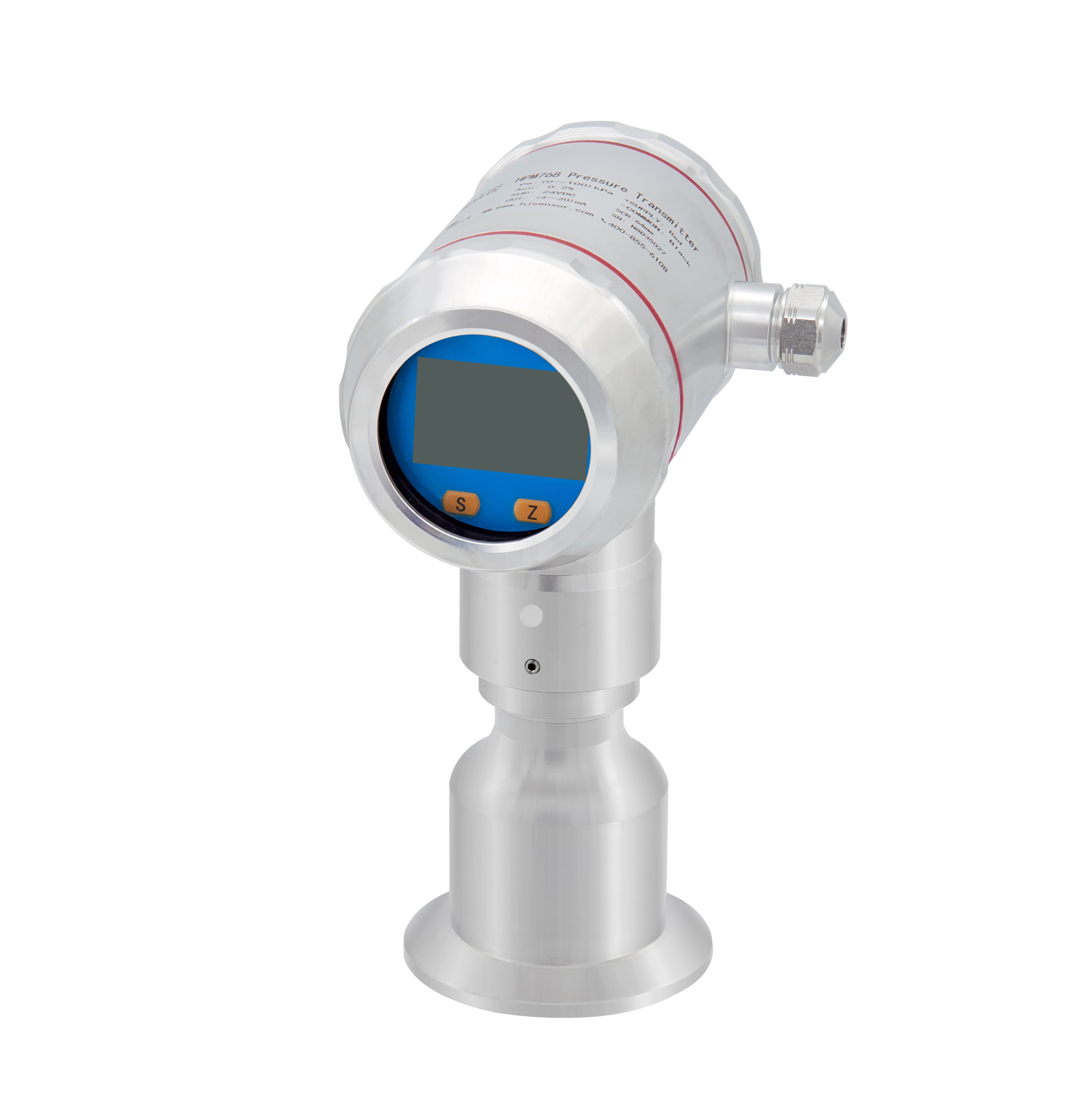
A Flush Diaphragm Sanitary Pressure Transmitter is engineered so the sensing membrane sits completely flush with the interior wall of the tank or piping system. This specific geometry eliminates dead legs. Fluid cannot stagnate and evade routine cleaning protocols.
By providing a smooth surface, the flat design allows for seamless Clean-In-Place and Sterilize-In-Place execution. High-velocity caustic chemicals can sweep across the sensor face without obstruction. For instance, when a CIP system flushes caustic soda at 2.5 meters per second, the flush membrane ensures all organic material is completely scoured away between production batches.
Because the process-facing diaphragm must withstand the mechanical stress of cleaning while detecting micro-pressures, internal construction is vital. Many instruments use an isolation membrane backed by a microscopic volume of FDA-approved fill fluid. The low process pressure pushes against the outer face. The force transfers through this incompressible fluid to a highly sensitive internal element safely away from harsh media.
The Power of Ceramic Technology in Micro-Pressure
While stainless steel diaphragms with oil fills are common, ceramic technology has rapidly emerged as the premier solution for micro-pressure measurement in demanding hygienic environments.
A Low-Pressure Ceramic Sanitary Pressure Transmitter utilizes a sensing element made from 99.9 percent high-purity Aluminum Oxide. This material possesses unique physical properties. It is incredibly stiff and dimensionally stable. Yet, precision machining can reduce it to extreme thinness.
In a capacitive setup, the ceramic diaphragm acts as one plate of a capacitor. As micro-pressure applies, the diaphragm deflects by microscopic amounts. Onboard electronics instantly convert this capacitance change into a precise 4-20mA digital signal. Furthermore, high-purity ceramic resists almost all corrosive cleaning chemicals. Operating as a dry cell means there is zero risk of oil contamination leaking into your process media.
Sudden pressure spikes, like water hammer during rapid valve closures, frequently destroy sensitive sensors. Standard metallic diaphragms deform easily under these conditions. Ceramic sensors naturally offer massive overpressure capabilities. The sensing face is supported by a rigid substrate located just micrometers behind it. It acts as a physical stop. The sensor can withstand overpressure events up to 100 times the nominal measuring range without a permanent zero-point shift.
Core Comparison: Metal vs. Ceramic for Low Pressure
Feature | 316L Stainless Steel (Oil-Filled) | 99.9% Al2O3 Ceramic (Dry Cell) |
|---|---|---|
Micro-Pressure Sensitivity | Good, but requires extremely thin, fragile foils. | Excellent, highly stable capacitive measurement. |
Overpressure Protection | Low. Easily permanently deformed by water hammer. | Extremely High. Up to 100x nominal range due to physical backplate. |
Contamination Risk | Moderate. Membrane rupture leaks silicone oil into media. | Zero. Dry cell technology contains no fill fluids. |
Corrosion Resistance | Susceptible to pitting from aggressive CIP acids over time. | Nearly impervious to all standard CIP/SIP chemicals. |
Key Field Applications for High-Precision Transducers
Understanding the physics is only half the equation. Applying it correctly to industrial processes is where true operational value emerges. These highly sensitive instruments are deployed in several critical use cases where precision and purity intersect.
In pharmaceutical and brewing facilities, determining the exact volume of liquid inside a fermentation tank is critical. Engineers achieve this by measuring the hydrostatic pressure at the bottom of the vessel. In small-scale pilot bioreactors, the total hydrostatic head pressure is extremely low. A highly accurate Low-Range Hygienic Pressure Transducer is required to convert this slight force into a precise level reading. A pressure variance of just 5 mbar can disrupt the media feed rate, ruining optimal cell culture growth.
Specifically, biotech research requires strictly controlled environments. Cleanrooms utilize positive air pressure to ensure airborne contaminants are pushed outward when doors open. The differentials between cleanroom zones are often measured in fractions of a millibar. Sensitive transducers continuously monitor these slight positive pressures in the HVAC systems.
Sanitary filtration removes impurities before final packaging. As the filter captures particulates, it begins to clog, causing a pressure drop across the membrane. Installing low-pressure transmitters upstream and downstream lets operators monitor the differential pressure. This data tells maintenance teams exactly when a filter approaches the end of its functional life, optimizing operational costs.
Engineering Guide: Choosing the Right Instrumentation
Selecting the correct instrumentation requires a careful evaluation of sensor physics and mechanical design. Engineers must look beyond basic ranges and evaluate how the device performs under rigorous processing conditions.
In low-pressure measurement, environmental variables exert a disproportionate influence on accuracy. Temperature is the most significant factor. During standard SIP cycles, equipment is exposed to steam exceeding 135 degrees Celsius. For a conventional oil-filled sensor, rapid thermal expansion causes internal fluids to press against the diaphragm. This registers as a false pressure spike, known as temperature drift.
When measuring micro-pressures, minor thermal expansion completely overshadows actual process data. Therefore, you must select a Micro-Pressure Ceramic Pressure Transmitter equipped with active temperature drift compensation. High-end devices utilize internal thermistors and cooling fins to handle SIP temperatures up to 150 degrees Celsius. Onboard electronics apply complex algorithms in real-time to correct the output signal.
The physical integration of the sensor is equally critical. Hygienic connections must adhere strictly to industry standards. The Tri-Clamp utilizes a gasket and mechanical clamp to create a seamless seal. For applications requiring threaded connections, specialized sanitary threads like the DIN 11851 milk pipe fitting ensure the fluid path remains flush. The surface roughness must be maintained below Ra 0.76 micrometers to inhibit bacterial adhesion.
Managing Vacuum and Negative Pressure States
Process engineering frequently involves complex fluid dynamics. Pumping systems, vacuum distillation, and bottling lines often experience states of negative pressure alongside standard positive flows.
A common technical inquiry is whether a single analog sanitary pressure transmitter can accurately measure both low positive and negative pressure conditions. The empirical answer is yes, provided it is calibrated as a compound sensor. Gauge pressure sensors reference ambient atmospheric pressure utilizing a vented cable. When the process drops below ambient, the sensor registers this as a negative gauge value, such as negative 200 mbar.
Measuring vacuum introduces specific physical challenges. In traditional oil-filled sensors, deep vacuum conditions cause internal silicone oil to outgas or boil at ambient temperatures. This permanently damages the membrane. Because a ceramic capacitive sensor is a dry cell with no internal fluid, it is completely immune to outgassing. It handles full vacuum conditions repeatedly without degradation.
Evaluating Total Cost of Ownership and Reliability
Procurement decisions in process automation involve balancing initial capital expenditure against long-term operational reliability. In the realm of micro-pressure measurement, this balance is delicate.
The market is saturated with generic, budget-friendly sensors. While these perform adequately in high-pressure utility lines, they introduce severe risks in low-pressure hygienic environments. Low-cost alternatives utilize thinner, lower-grade stainless steel diaphragms. They are highly susceptible to mechanical fatigue and zero-point drift. In a bioreactor, an undetected drift can lead to the loss of an entire production batch. The financial impact of a single ruined batch exponentially outweighs the savings gained by purchasing a budget instrument.
Evaluating the Total Cost of Ownership is essential. High-quality transmitters constructed from premium materials like 316L stainless steel offer excellent resistance to caustic soda and nitric acid. Investing in ceramic technology drastically extends life expectancy. A low-cost unit might require replacement every 12 months due to chemical degradation. In contrast, a highly engineered ceramic model reliably operates for over 5 years, reducing maintenance downtime.
Conclusion
Measuring minute pressure variations in hygienic environments is entirely possible with the correct instrumentation. The challenges of balancing extreme sensitivity with aggressive cleaning protocols have been successfully met by modern engineering.
Choosing a specialized ceramic sensor or a highly engineered flush diaphragm device guarantees the accuracy needed for tight process control. It ensures the hygiene required for strict safety compliance. By prioritizing advanced materials and active temperature compensation, facilities eliminate batch contamination risks and drastically reduce their total cost of ownership.
Do not compromise your process integrity with standard sensors. Contact the engineering team at HJ Sensor to discuss your specific application needs. Browse our comprehensive catalog at https://www.hjsensor.com to find the exact micro-pressure configuration tailored for your facility.
FAQ
What is the minimum pressure range a sanitary pressure transmitter can measure?
High-quality micro-pressure transmitters can measure ranges as low as 0 to 10 mbar with exceptional accuracy. Achieving this requires highly sensitive sensor technology, typically utilizing capacitive ceramic cells or specialized piezoresistive silicon chips. The exact minimum range depends on the specific engineering of the diaphragm and the signal processing electronics filtering out ambient noise.
Why is a flush diaphragm necessary for low-pressure sanitary applications?
A flush diaphragm is mandatory to prevent the accumulation of bacteria, organic media, and product residue. Traditional sensors feature recessed cavities where fluid becomes trapped and evades cleaning chemicals. A flat design ensures the sensor face sits perfectly even with the internal pipe wall, allowing CIP processes to effectively sterilize the entire surface.
Can a hygienic transducer withstand high-temperature cleaning?
Yes, purpose-built hygienic transducers are engineered explicitly to withstand extreme thermal conditions. Most high-quality devices endure CIP and SIP temperatures up to 135 degrees Celsius. Specialized models utilize cooling fins and active temperature compensation algorithms to withstand up to 150 degrees Celsius for short durations without signal drift.
Which is better for micro-pressure: silicon or ceramic sensors?
Ceramic is generally preferred in harsh sanitary environments. High-purity ceramic provides exceptional resistance to aggressive chemical cleaning agents. Capacitive ceramic sensors function as a dry cell without internal fill fluids, eliminating the risk of fluid contamination. They also inherently possess a superior ability to absorb high overpressure spikes without permanent deformation.
How often should I calibrate a low-pressure sanitary transmitter?
Because low-pressure sensors operate within highly sensitive margins, they are susceptible to minor environmental shifts. An annual calibration is generally recommended as a baseline best practice. However, highly stable ceramic models often exhibit negligible zero-point drift, allowing facilities to extend this cycle to 18 or 24 months based on their Quality Management System.
How does temperature affect low-pressure sanitary transmitters?
Temperature fluctuations cause thermal expansion of the internal fill fluids and metallic components. In micro-pressure ranges, this expansion pushes against the sensing diaphragm, creating a false pressure reading known as zero-point drift. High-end transmitters combat this by using active electronic temperature compensation and dry-cell ceramic technology to ensure accurate readings during thermal shocks.
What is the difference between gauge and absolute pressure in sanitary applications?
Gauge pressure measures pressure relative to ambient atmospheric pressure. It is critical for open tanks or vented systems where atmospheric changes must be factored out. Absolute pressure measures pressure relative to a perfect vacuum. It is essential in closed sterilization systems and vacuum distillation processes where true pressure independent of weather or altitude is required.


